Discussing AI and its place in our world
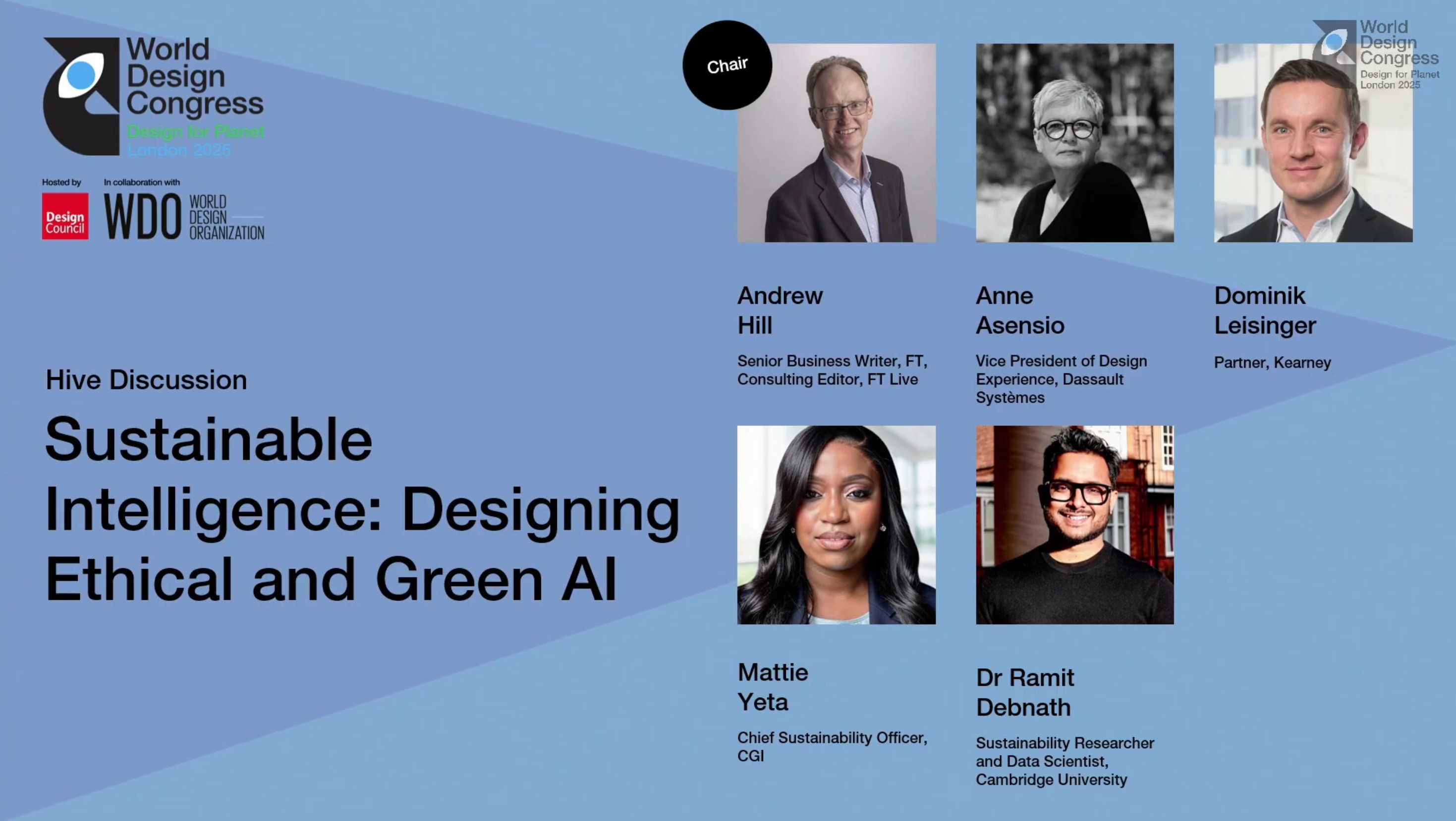
This week I watched “Sustainable Intelligence: Designing Ethical and Green AI” from the Design Council’s 2025 London conference. In the speech it was discussed how Artificial Intelligence (AI) may impact Design, and how it can be used effectively, and ethically.
Personally, as a computer nerd since forever, AI is fascinating. To me, the concept of AI - as I see it, taking all of the world's data, information, research and knowledge and collating it into a massive, easily searchable, conversationalist database - seems like the next logical step for humanity as a whole. Humans have evolved to the position they have through 4 main things: conscious learning, maths, tool-use, and communication. AI, fundamentally, is the pinnacle of those traits, we have bent nature to our will to create our own tool capable of calculating maths, retaining inordinate quantities of information, and communicating that with us. AI has undoubtedly made the most amount of human knowledge the most accessible it has ever been - people are able to talk to it conversationally, they don’t need to (necessarily) find an expert in a given field, or know key terms for something they’re trying to Google; they don’t have to retain everything either, you can read back through the conversation or simply ask the AI for a reminder on a subject you remember only vaguely. Never before has such a vast library of data been this easily navigable, and with all knowledge being built on what came before it, it can only accelerate humanity’s capacity to develop and evolve and streamline our efficiency.
But that is simply the ideal, the vision. The reality, as it often does, has caveats, drawbacks and nuances. Those forefathers who did create all the data, information and knowledge that modern AIs exist upon are far too often not compensated for their efforts. AI can also misinterpret nuanced data, and is still a tool built, owned, and run by humans - humans which are evolutionarily disposed to being self-centred and self-serving; AI can be manipulated and its outputs controlled, which can lead to the squandering of data and information deemed “against status-quo”, furthermore it's operations are often run at the lowest costs possible with no regard for environmental drawbacks. There is also the concern that with such easy access to an external memory dump, people will begin to rely less and less on their own natural one - why would they when just asking AI is so much easier, and evolution did make us seek the easiest, least energy-intensive route in all things, even if it could later lead to our detriment. There is also the energy, and the water considerations. On one hand AI could compute long mathematical equations to help streamline our current methods to become sufficiently efficient such that it outweighs the cost of running AIs, as mentioned by Mattie Yeta in the talk, but on the other hand that relies on humans implementing those changes and we naturally dislike change - that requires adapting, and adapting requires effort and energy, the things we're predisposed against.
Ultimately, I personally like the vision of AI and its uses; I use it, most often as a tool to help teach and guide myself as I tinker with my various and numerous projects, but I’m not sure it’s fully there and I definitely believe it needs regulating to minimise the damage it causes in its current state.
← Back to all posts